

The convergence of Generative AI in CRM marks a new era in business technology. With Generative AI, CRM systems have the ability to automate complex tasks, personalize interactions, and generate actionable insights at scale. For businesses, AI CRM integration is no longer a future vision but a strategic necessity.
This guide explains how generative AI works inside a CRM, the key benefits, the top use cases, a real-world example, and how to implement it well.
What is Generative AI and how does it work in a CRM?
Generative AI is advanced artificial intelligence with the ability to create new content, perform complex work, and create deep insights through learning from vast datasets.
Generative AI in CRM applies natural language processing, predictive analytics, and data automation to:
- Draft customized, on-brand communications: emails, follow-ups, reminders, and updates.
- Automate case and record management, from data entry to categorization and routing.
- Analyze client interactions to produce summaries, sentiment, and next-best-action recommendations.
Modern platforms including SugarCRM and Salesforce now embed these capabilities natively, letting firms manage high volumes of client data, automate documentation, and deliver personalized support while maintaining accuracy and compliance.
Traditional CRM vs. AI CRM
The difference is the shift from recording work to doing it:
| Capability | Traditional CRM | AI CRM |
|---|---|---|
| Communications | Manual drafting from templates | AI drafts tailored messages in seconds |
| Data Entry | Staff key in and update records | Auto-capture, enrichment, and deduplication |
| Insights | Static reports and dashboards | Real-time summaries, sentiment, and next-best-action |
| Support | Agents answer every query | AI assistants handle routine queries; agents take complex cases |
| Forecasting | Manual pipeline review | Predictive scoring and forecasting |
How Generative AI Integrates with CRM
Generative AI becomes significantly more useful when it is connected to the CRM and the business systems around it. Instead of operating as a standalone assistant, it can use customer data, interaction history, documents, and business rules to generate insights, recommend actions, and trigger workflows.
A typical AI-powered CRM workflow looks like this:
CRM data → AI analysis → Business context → AI output → Workflow/action → CRM update
For example:
- Capture the interaction: A customer contacts the business through email, phone, chat, or a portal.
- Retrieve customer context: The CRM provides relevant information such as contact details, previous interactions, open cases, and transaction history.
- Analyze with AI: Generative AI interprets the interaction and combines it with relevant customer and business data.
- Generate an output: The AI can create a response, summarize the interaction, recommend a next action, or identify an issue requiring attention.
- Trigger a workflow: Based on predefined rules, the CRM can create a task, route the case, send a follow-up, or escalate the interaction to a team member.
- Update the CRM: The interaction, summary, recommendation, or resulting action is recorded automatically, keeping the customer record current.
- Keep humans in the loop: Staff can review AI-generated outputs or take over when an interaction involves sensitive, complex, or high-risk decisions.
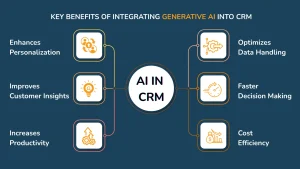
Key Benefits of Integrating Generative AI Into CRM
Enhanced Personalization
With generative AI customer experience solutions, companies are able to segment clients by their individual profiles and needs. Dynamic content generation makes sure that each message, whether a status update, a reminder, or a follow-up, is on time, relevant, and compliant.
Increased Productivity
Integration of AI with CRM automates repetitive administrative work like data entry, appointment scheduling, and document management. Your staff then gets the freedom to focus on high-value client consultations and complex casework.
Improved Customer Insights
AI customer relationship management delivers in real-time analysis of client communications and sentiment, allowing you to identify at-risk clients, set priority on mission-critical cases, and respond to concerns proactively, which is critical for companies handling sensitive financial matters.
Data Management Automation
Generative AI keeps client records always up-to-date and accurate by automatically cleansing, enriching, and deduplicating data. Integration with other business apps delivers a single, 360-degree view of each client’s journey.
Faster Decision Making
AI-powered dashboards and assistants give instant access to case histories, compliance alerts, and actionable insights, allowing your staff to make rapid and informed decisions.
Cost Reduction and Scalability
With automation of repetitive tasks, AI-powered CRM systems allow your law firm to service more clients and complex cases without commensurate increases in staff, thus realizing utmost scalability and profitability.
Top Use Cases for Generative AI in CRM
Sales Automation
AI can qualify leads, summarize prospect interactions, generate personalized follow-up emails, recommend next-best actions, and keep pipeline records updated. This helps sales teams spend less time on administrative tasks and more time building client relationships.
Marketing Personalization
Generative AI can use CRM data such as customer profiles, interactions, preferences, and engagement history to create more relevant marketing communications. Firms can personalize emails, newsletters, offers, and follow-ups for different client segments while automating content variations and campaign workflows.
Customer Support
AI-powered assistants can answer routine questions, summarize customer interactions, categorize cases, and route complex issues to the right team. When connected to the CRM, they can use customer history and previous interactions to provide more contextual support while keeping records updated.
Data Management and CRM Enrichment
AI can identify incomplete or duplicate records, extract information from customer interactions and documents, summarize account activity, and support data-enrichment workflows. When combined with system integrations, this helps maintain a more complete and consistent customer record.
Workflow Automation
Generative AI can work alongside CRM automation to initiate and support multi-step processes. For example, an interaction can trigger a CRM update, create a task, generate a follow-up message, route a case, or escalate an issue to a human team member based on predefined business rules.
Case Study Spotlight: Real-World AI CRM Integration Success
Nablasol’s partnership with Community Tax exemplifies how AI-driven CRM automation can transform customer experience and operational efficiency. By automating workflows across marketing, lead management, case handling, and integrating phone systems with SugarCRM, Community Tax achieved an 80% same-day client enrollment rate and improved customer engagement across multiple touchpoints. This case highlights the power of an AI CRM system to streamline complex processes and deliver superior client service.
Implementation Tips and Best Practices
Assess Readiness
Evaluate your current CRM and data management processes to ensure a smooth transition to AI-powered solutions.
Choose the Right Tools
Choose tools that offer strong security, compliance features, and seamless integration with your existing tech stack.
Pilot and Scale
Pilot AI capabilities in a single department or process to measure impact before scaling.
Monitor and Refine
Use analytics to track performance, refine AI models, and ensure ongoing compliance and quality.
Challenges and Considerations
Data Privacy
Ensure your AI-powered CRM complies with all relevant regulations and protects sensitive client data at every step.
Change Management
Prepare your team for new workflows and foster a culture of innovation and continuous improvement.
Continuous Learning
Regularly update AI models with new data and feedback to maintain accuracy and relevance.
Conclusion
Integrating generative AI into CRM is a strategic move for firms that want to deliver exceptional, compliant client service. The combination of automation, personalization, and actionable insight positions your organization to thrive in an increasingly complex, regulated environment.
Nablasol helps firms implement generative AI, agentic AI, CRM automation, and system integrations. Since 2015, the team has delivered 263+ digital solutions and 125+ system integrations, including CRM automation for clients.
Ready to identify where AI can create the most value in your CRM?
Book a free 30-minute assessment with Nablasol to map your opportunities and define a practical implementation plan.
FAQs
How AI helps in CRM?
AI helps CRM by automating tasks, personalizing customer interactions, providing real-time insights, improving sales and marketing efficiency, enhancing customer support with chatbots, and ensuring accurate data management. This boosts productivity, customer satisfaction, and business growth.
What is CRM automation?
CRM automation uses technology to automate repetitive tasks like data entry, lead nurturing, and customer follow-ups, improving efficiency, accuracy, and customer engagement while freeing teams to focus on strategic work.
What is the future of AI in CRM?
The future of AI in CRM involves smarter automation, predictive insights, hyper-personalization, enhanced customer support, real-time decision-making, and stronger data security, helping businesses improve efficiency, engagement, and growth.
What kind of AI is used in customer service?
Customer service uses AI like chatbots, natural language processing (NLP), intelligent ticket routing, generative AI for personalized responses, and predictive analytics to automate support, understand customer needs, and improve response times.
What is AI in taxation?
AI in taxation uses technologies like machine learning and generative AI to automate tax filing, analyze data for compliance and fraud detection, provide personalized taxpayer assistance, and streamline complex tax processes for greater efficiency and accuracy.